Every tracker can add up what you ate. The question is what happens next, and for most of
them the answer is nothing — you are handed a number and left to work out dinner yourself.
It answers “so what do I eat?”
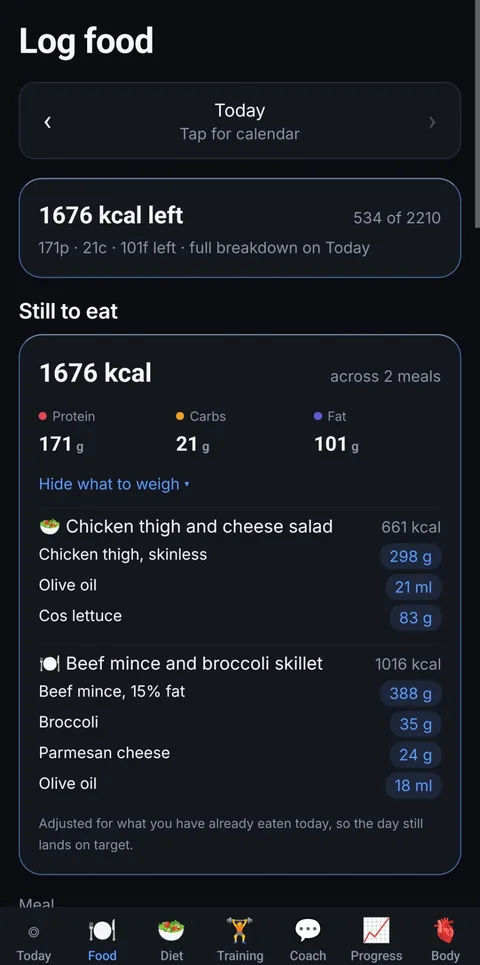
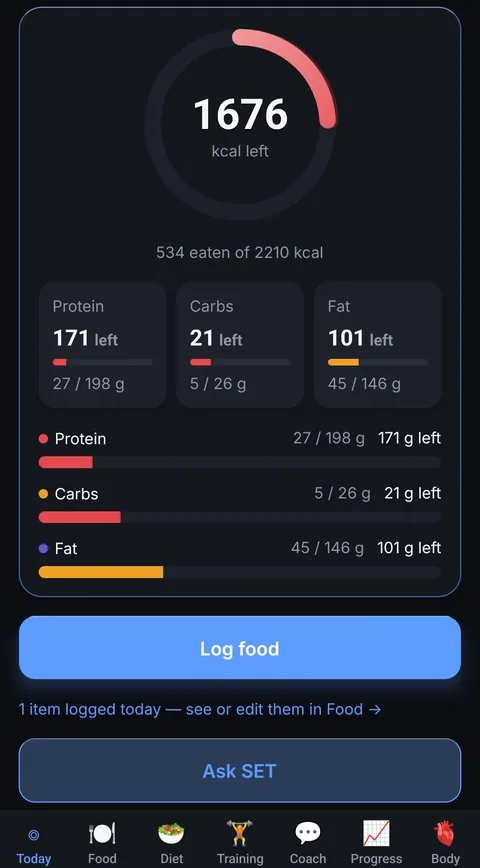
“603 calories left” is not an instruction. Setpoint says 180 g of chicken,
95 g of rice, and the number moves the moment you log something that was not in the
plan. Most apps stop at the first half.
An off-plan lunch is not a ruined day
Eat the thing. The remaining meals shrink or grow to absorb it, protein is protected
first, and the day still lands on your target. That is the difference between a plan
you follow and a plan you abandon by Wednesday.
Australian food, Australian data
Whole foods come from the official Food Standards Australia New Zealand database — the
cuts sold here, and entries that say raw, baked, fried or casseroled. Weighing cooked
chicken against raw figures undercounts you by nearly a fifth, and most apps never
mention which one you are looking at.
Added sugar, not just total sugar
Most apps show one sugar figure, which puts an apple and a can of soft drink in the same
number. Eat three pieces of fruit and you read 60 g of sugar and conclude the fruit
is the problem — while the guideline you were given was only ever about the added
part.
Setpoint shows them separately, and it never guesses which is which. Calling the sugar in
fruit and milk intrinsic and everything else added sounds sensible and is wrong in both
directions. The added figure comes from the food databases that publish it, and the app
tells you how much of your food that covers rather than passing off a partial total as a
whole one.
Vitamins and minerals, and how much of them it knows
Thirteen of them — iron, calcium, B12, folate, zinc and the rest — from the same
Australian database, for meals out of your plan as well as anything you search or scan.
Every figure says what it was built from: from 5 of 7 foods logged. Other apps
draw a tidy ring per nutrient, which can only be filled by counting “not
recorded” as zero — and a total built that way reads low and reads confident.
Ours is less tidy, and does not mislead you.
And when one of them has been genuinely low for a fortnight, Setpoint names it and
suggests three foods that would fix it — ranked by how much they carry per
calorie, so they fit inside your target, and filtered by what you actually eat.
It stays quiet unless enough of your food carried a real figure to be sure.
The AI never invents a number
A model identifies the food and estimates the portion. Every macro figure comes from a
nutrition database. If nothing matches, the item is flagged as an estimate rather than
quietly counted as fact.
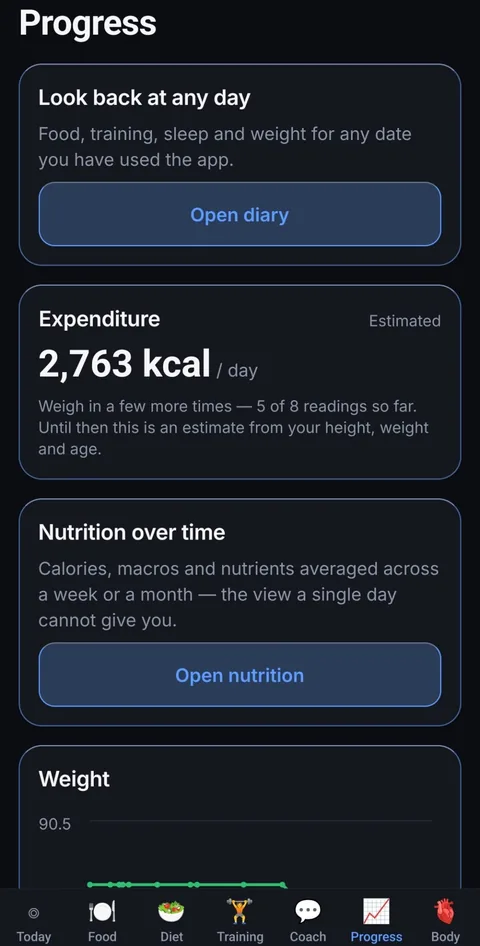
It notices when your expenditure moves
A fall in expenditure caused by being lighter is normal arithmetic. A fall beyond that
is worth knowing about, and Setpoint separates the two so you can see which you are
looking at rather than assuming the worst.
You can also tell it a stretch of days was not you — gastro, a holiday, a week of
antibiotics. Those days are left out entirely rather than fudged, so the estimate says
it is less sure rather than pretending nothing was lost.
The scale isn’t telling the whole story
Carbohydrate is stored as glycogen, and glycogen carries water with it. Salt shifts water
too. So after a high-carb or salty day the scale can jump even when you have not gained
meaningful body fat — gaining a kilogram of fat takes a large sustained energy
surplus, roughly 7,700 kcal by the usual estimate, which one evening does not supply.
Setpoint shows you what is likely behind the movement: how much glycogen and associated
water your recent carbohydrate could be carrying, alongside the last seven days of your
own intake. Instead of seeing “+400 g” and guessing, you can see what
changed in the days before it. Scroll back through the diary and it shows the same
picture for any previous day.
And once you have logged enough morning weigh-ins, it stops relying on textbook averages
and starts measuring your response. Some people see large swings after a high-carb day.
Others barely move. Setpoint works out which pattern looks like yours.
The scale is measuring your weight. Setpoint helps you understand it.
Reminders that know what you have already done
A nudge at each meal time you choose, and a weekly weigh-in. A meal you have already
logged is never mentioned. No streaks and no daily score — those exist to make you open
an app, which is not the same as helping you.
The weigh-in matters more than it looks. It is the measurement your expenditure figure
is built from, so a missed one does not just lose a data point, it holds up the number
the whole app is for.
One line a day, and only when it is true
Optional, and not a motivational quote. Each morning Setpoint can tell you one thing
about your own numbers: how close your expenditure estimate is to being measured rather
than guessed, that tomorrow's weigh-in closes out the week it is fitted to, or that
you have hit your protein target on twenty-five days now.
On a day when there is nothing true to say, it says nothing. That is the whole design.
Every other tracker can send "don't forget to log" — none of them can tell you how many
days of your own data the estimate is built on, because none of them measure it.
Trophies for what you did, not what you weigh
Logged thirty days. Twelve weigh-ins. Fifty training sessions. Never a kilo lost — weight
is only partly in your control, and an app that rewards eating less is a different and
worse thing.
Nothing counts a run of days, so nothing can be broken by a holiday or a week of being
ill. And there is no list of the ones you have not got: the wall is empty when you start
and fills as you go, because a checklist of things undone is not what a food app should
be showing anybody.
Groups, with people you actually know
Start a group, share the code, and compare the month with up to twenty people you
invited. Sessions trained, weight moved, days logged, trophies earned — and steps, if
you switch them on. First names only, with a chat you can send photos in. Part of the
subscription.
There is no public leaderboard and no way to find a group you were not given the code
for. Your weight, your body fat, what you ate and how close you came to your calorie
target are never shown to anybody, in any group, and there is no setting that would.
Ranking people on how little they ate is a competition this app will not run.
Contest prep, inside the app you already use
Dedicated prep apps exist and some of them are good. What Setpoint does differently is
run the prep on the same engine as the rest of your year: the expenditure figure it has
been measuring from your own logs and weigh-ins for months is the one your prep is
planned from, rather than a fresh calculator starting from nothing.
Enter your show date and division and Setpoint works backwards from it. The first thing
it does is tell you whether the date is reachable — and if it is not, it shows the
arithmetic and the date that is. Finding that out on day one means entering a different
show. Finding out at week ten costs a season.
Then one tap writes the whole thing: your targets, a meal plan with however many meals a
day you want, and a training programme built for your division. Not three screens and
two other tabs — one.
Prep food is expensive and Setpoint says so rather than letting you find out at the
till. Your protein target during a prep is the highest the app ever sets, and protein is
the costliest way there is to fill a calorie target — so if the week’s shop
is going to overrun the grocery budget you set, the prep screen tells you by how much.
It does not quietly rewrite the plan cheaper, because the only way to make a prep
meaningfully cheaper is to take the protein out. Peak week included — that is
the most expensive shop of the whole prep and the worst week to be surprised by it.
From there it is the app you already have, pointed at a deadline: targets set week by
week from your measured expenditure, meals and training built against them, and
a pace that runs harder early and eases as you get lean — because that is when a
deficit starts costing muscle rather than fat.
Cardio is treated as a budget you spend rather than a baseline you set. It starts at an
hour a week and climbs — slowly at first, steeply near the end, because the extra
work is only worth its recovery cost in the stretch where the deficit can no longer come
out of food. The common way to get this wrong is starting high: six long sessions at
sixteen weeks out feels productive and leaves you nowhere to go when the scale stalls at
week six. Mostly low-intensity, because intervals compete with your lifting for the
recovery that is already scarce, and none at all in peak week — that week exists to
put glycogen in, and cardio takes it back out.
It is never converted into calories and never subtracted from your food. Setpoint already
measures what you burn from what you logged and what the scale did, so the cardio you
actually do is in that figure — counting it a second time would cut your food twice
for the same work.
Through the middle of it, the question that actually matters is whether you are on the
line. Setpoint draws the trajectory your plan expects — a curve rather than a
straight line, because losing faster early and easing off as you get lean is the plan,
not a deviation from it — and compares it against your weight trend rather than
this morning’s reading.
And when you are behind, it shows you what that costs rather than telling you what to
do. Two futures, both real: carry on at the rate you have actually been losing and be
ready some weeks after this show, or hold the date and here is the rate that takes
— including when that rate is past what muscle survives. Setpoint will not pick.
It knows the arithmetic and none of the things that actually decide it.
The final week is planned day by day: depletion, the carb load scaled to your lean mass,
the training taper, and show day timed backwards from when you are called to the stage.
Water loading is explained properly, with the risks at both ends, and you set your own
figures — Setpoint tracks them, it does not prescribe them. Diuretics and sweating
weight off it will not plan at all.
Then it walks you back up, and it reads you rather than a textbook. Steady weight means
room to feed you faster; a real climb eases the pace. It deliberately ignores the first
fortnight, because weight after a show rises whatever you do — that is glycogen
refilling and bringing its water with it, and treating it as fat would leave you
under-fed for weeks on the strength of the one gain the app already knows is not fat.
That stretch decides whether the next twelve months are good or miserable, and it is the
part people are most often left to work out alone.
The coach knows about it too, so “why did my calories change?” gets an
answer about your show and your week rather than a general one about expenditure.
Fourteen divisions across both sexes, and one for anything a federation has added that
Setpoint has not heard of yet — the timeline and the targets work the same either
way.
Then one more question: novice, experienced, or masters. A first show gets four extra
weeks of runway, because nearly every prep people regret is one that started too late
and got made up for with crash dieting in the last month. Masters gets three extra weeks
and a lower ceiling on how fast the weight comes off — muscle is harder to
hold and harder to rebuild than it was, so the same deficit costs more. If you are over
35 and it is also your first show, pick masters: it is the more careful of the two, and
nothing here decides which classes you enter on the day.
Stop it whenever you like. Setpoint works out a fresh target for the bodyweight you are
at now — not the one you started on, which is a number computed for a body you no
longer have — then rebuilds your meals and your training around it, in the
background, while you carry on using the app. A prep programme is not what you go back
to, and a prep plan built for a deficit is not either. Everything you have logged stays
exactly as it is. And when you finish, it asks the one question worth recording: did you
come in flat, about right, or spilled? That answer, the weight you came in at and
whatever you wrote down are waiting for you when you set up the next one — and in
peak week, which is the only week you can still act on them. A year is long enough to
forget what you loaded on. Setpoint does not change anything on the strength of it; it
puts last time in front of you and the call stays yours.
Never used if you do not compete. It is one card on the Diet tab, and the rest of the app
is unchanged.
Training for a race, not a stage
The same countdown, pointed at a different job. Setpoint works back from the date
— but the goal here is arriving able to perform, not arriving at a weight, and
almost everything follows from that one difference.
Twenty-eight events across seven disciplines, because not everybody runs. Running from
a 5k to an ultra, and trail as its own thing. Walking
and trekking — a 5k walk, a half marathon walk, and the 50 and 100 km
charity treks that have taken six figures of Australians over a coastline. Cycling, road
and mountain and multi-day. Open water swimming,
from an ocean swim to a marathon channel crossing. Triathlon from sprint to Ironman, plus
duathlon, aquathlon and adventure racing. And
fitness racing — Hyrox, DEKA, Spartan,
Tough Mudder.
It asks how long you expect to be out there rather than how far you are going, because
that is what decides the answers. A four-hour marathoner and a two-and-a-half-hour one
are running the same race and solving different nutrition problems — and a 5k walk
and a 5k run are the same distance on opposite sides of the line where eating during it
starts to matter at all.
It does not rewrite your diet to suit the race.
Endurance runs on carbohydrate, and Setpoint will say so if your plan is low-carb and the
day is a long one — but saying so is where it stops. Your calories move, because
that is what working back from a date means. What you eat and how you split it stays
yours, and the app tells you what it would recommend rather than quietly doing it. The
race-day fuelling plan applies whatever you eat the rest of the week.
Losing weight is off by default, and the default is
the advice. A deficit is a cost paid against the race. Setpoint will run a
shallow one early if you ask, and switches it off entirely once the taper starts
— glycogen cannot be filled out of a deficit, and the last few weeks are when the
training you have already done actually lands.
Then the part most apps have nothing for: what goes in during it. Grams of
carbohydrate an hour, scaled to your expected time, with the reason the number changes
rather than just the number — above about 60 g an hour one of the gut transporters
saturates, so it needs glucose and fructose together. More of a single-source gel does
not absorb faster, it just ruins your stomach at 30 km. And the carb load before it,
with no depletion phase, because the deplete-then-load protocol is decades out of date.
And then the part that makes the second race better than the first. When you finish,
Setpoint asks one question: did you run out, did it hold, or did your stomach turn
— and what did you actually take an hour, not what the plan said. Next
race that comes back to you instead of the textbook.
60 to 90 grams an hour is a population range, and
nobody’s gut is a population. The rate that stayed down in a real race is
your own number, and a year later nobody remembers it. Setpoint does not change your
plan on the strength of it — it puts last time in front of you and the call stays
yours.
It writes the training as well as the meals, and the shape of the week is the point.
Most of it is easy — one long session,
at most two genuinely hard ones, and everything else at a pace you could hold a
conversation through. That is not a soft option, it is the most robust finding in
endurance training, and the failure it prevents is the common one: a whole week at a
middling effort that feels productive, is too hard to recover from and too easy to
adapt to. The plan is built so it cannot write that week.
Strength work stays in rather than being dropped, which is the first thing endurance
athletes cut when the hours climb and the thing the evidence is clearest about for
staying uninjured. An easier week every fourth, because adaptation happens during the
recovery and not the work. And the taper cuts the volume while keeping the frequency
— dropping sessions instead feels like resting and loses the feel for the sport in
the fortnight it matters most.
Sessions come in minutes and effort rather than sets and reps, and the app logs them
that way: a treadmill session asks for time, effort and incline. It will not write a
programme for
something else — if Setpoint has not been told the sport, a session plan
would be invented rather than worked out, and it says so instead of guessing. None of
this is coaching. It is a defensible default week, and a coach who knows your history
and your injuries beats it comfortably.
The event screen is the prep screen, deliberately. The same countdown in the same
place, the day’s calories and carbohydrate
under it, the week’s carbs moved towards the days you actually train, what the
week’s shop costs against your grocery budget, and one tap each to log your food
or open your session. Two different sports, one screen you only have to learn once.
And when the day has been — or when it is not going to happen, which is the more
common ending — Setpoint hands you back an ordinary plan. Your calories go back to
what the app would set for you now, and the meals and the training are rewritten to
match. That matters more here than it sounds: a programme written for a 90 km ride is
still a programme written for a 90 km ride the week after you have stopped riding it.
There is no trajectory here and nothing telling you that you are behind. That belongs on
a contest prep, where somebody is genuinely racing a body composition. Telling a
marathoner six weeks out that their weight is not falling fast enough is not motivation,
it is bad advice.
Are you eating enough for what you are doing?
Eating 2,600 calories sounds like plenty. It is not, if two hours of running took 1,100
of them and you carry 55 kg of lean mass — that leaves 27 calories per kilogram to
run everything else on, and the line most sports scientists draw is 30. No calorie total
on its own shows you that.
That gap has a name and a long list of consequences: stress fractures, cycles that stop,
suppressed hormones, and the run of colds that ends a season. Endurance athletes are the
textbook case, and almost every tracker will happily watch it happen while showing green
numbers all week.
So Setpoint does not use a flat calorie floor for somebody training twelve hours a week.
It works out what is left after training, measured against your lean mass, and
raises the floor to cover it. It only ever raises one — a watch's calorie estimate
is never allowed to lower your target, which is the same rule the rest of the app
follows. And if it does not know your body composition it says so and asks, rather than
estimating your lean mass and then passing judgement on your fuelling.
A contest prep gets the same number and none of the
enforcement, and the difference is deliberate. A prep is the one place in the
app where somebody is supposed to spend months under that line — coming in
stage-lean is what it costs, and a rule forbidding it would forbid the sport. So the
prep screen shows what is left after training and changes nothing about your target.
Setpoint does not stop you, does not mark it in red, and does not offer to fix it: the
fix is time at maintenance after the show, not a change this week.
It matters most in the last stretch, and that is exactly where nobody is doing the sum.
Prep is the one diet where the app itself is pushing cardio up while pulling calories
down, month after month — the gap widens on both sides at once. Knowing you are
there is worth a great deal more than finding out afterwards, which is how most people
find out.
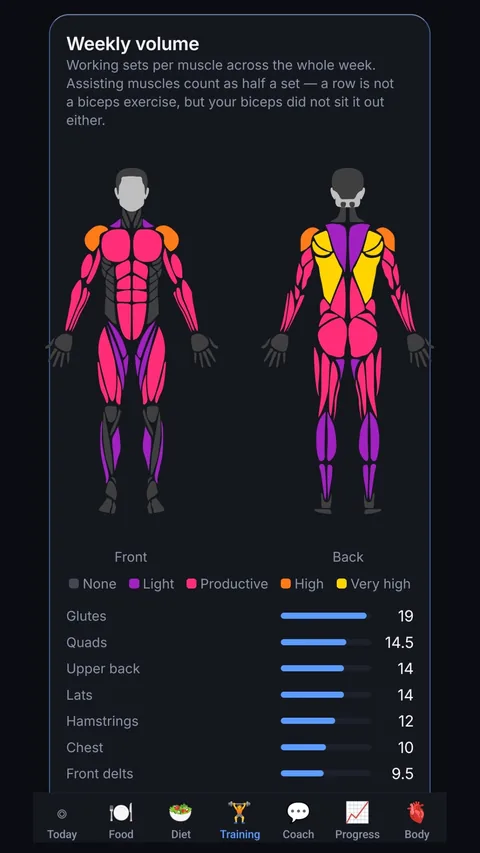
Training that remembers for you
Last session's reps and weights are already in the boxes. Change one digit to beat it.
A rest timer sits under every lift, set to that lift's own rest period.
Cardio is not an afterthought bolted onto a lifting app. A treadmill walk asks for
minutes, effort and incline — not reps and weight — so a finished session is
actually recorded rather than logged as three sets of nothing.
The programme is built to what you ask for, and
the choice is an instruction rather than a
suggestion. Pick full body, upper / lower, push / pull, push / pull / legs, or
one body part a day — and one body part a day means one. Not chest and triceps.
Tick the days you can train and it fits the split to your week rather than the other
way round, because the days are your life and the split is a preference. Each session
lands on its own day — Monday push, Wednesday pull — so the app shows you
today’s session, and says so plainly on a rest day. Tick
what equipment you actually own, down to “bands, a pull-up bar and a 24 kg
kettlebell”, and nothing gets prescribed that you do not have.
Emphasis is its own choice and it is not five settings on one dial. Strength,
hypertrophy, compound lifts and conditioning are there, and so are hybrid running and
lifting, calisthenics with the actual progressions, joint-friendly work for cranky
knees or a return from a layoff, and strength with balance and mobility built through
it — the last two being the kinds of training most lifting apps do not reach at
all.