Training programmes, built to your week
Built to the split, days and equipment you choose, and it keeps last week in front of you.
Training that remembers for you
Last session's reps and weights are already in the boxes. Change one digit to beat it. A rest timer sits under every lift, set to that lift's own rest period.
Cardio is not an afterthought bolted onto a lifting app. A treadmill walk asks for minutes, effort and incline — not reps and weight — so a finished session is actually recorded rather than logged as three sets of nothing.
The programme is built to what you ask for, and the choice is an instruction rather than a suggestion. Pick full body, upper / lower, push / pull, push / pull / legs, or one body part a day — and one body part a day means one. Not chest and triceps. Tick the days you can train and it fits the split to your week rather than the other way round, because the days are your life and the split is a preference. Each session lands on its own day — Monday push, Wednesday pull — so the app shows you today’s session, and says so plainly on a rest day. Tick what equipment you actually own, down to “bands, a pull-up bar and a 24 kg kettlebell”, and nothing gets prescribed that you do not have.
Emphasis is its own choice and it is not five settings on one dial. Strength, hypertrophy, compound lifts and conditioning are there, and so are hybrid running and lifting, calisthenics with the actual progressions, joint-friendly work for cranky knees or a return from a layoff, and strength with balance and mobility built through it — the last two being the kinds of training most lifting apps do not reach at all.
See your whole training week at once
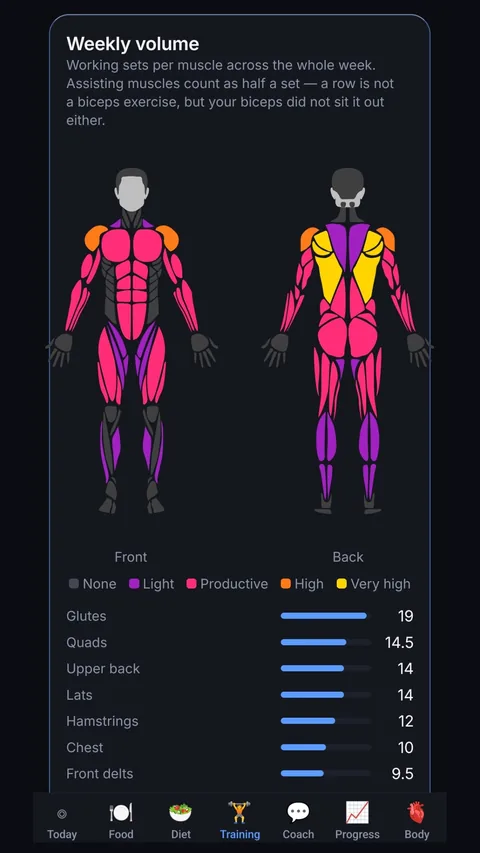
A programme is a list of exercises until you ask the only question that matters: am I doing enough of everything, and too much of anything?
Setpoint adds up your working sets across the whole week and attributes them to the muscles that did the work. Assisting muscles count as half a set, because a row is not a biceps exercise but your biceps did not sit it out either.
Twenty-two sets of chest next to four of hamstrings is obvious in a glance.
Open any exercise and the same figure shows that lift on its own — what it trains, and what merely assists.
And the program is built around what you actually own. Tick the kit in front of you — bands, one kettlebell, a pull-up bar, a full commercial gym — and nothing outside that list is prescribed. Nine emphases, from heavy compound work to calisthenics progressions, hybrid running-and-lifting weeks, and joint-friendly programming for anybody training around a bad knee or coming back after a layoff.
Beat last week without having to remember it
Open a lift and last session's reps and weights are already in the boxes. Tap the set number to record the same again, or change one digit to beat it. That is progressive overload, and it is most of the reason to write anything down at all.
A rest timer sits under every exercise, already set to that lift's own rest period. Tap the minutes or the seconds to change them.
Nothing is guessed on your behalf: a prefilled row is only saved once you confirm it, so a session you skipped never quietly records last week's work as this week's.
Nothing you log is final
Every day takes a note, and so does every session — whether a meal was worth repeating, whether a knee complained on the second set. Two boxes, because they are two different questions.
Mistyped a weigh-in? Correct it. Logged a session before you remembered your numbers? Edit it, or delete it. One fat-fingered weight drags a trend line for a fortnight, so it has no business being permanent.
Your watch data, handled honestly
Apple Health and Health Connect, so Garmin, Fitbit, Samsung Health and Google Fit all land in one place. Sleep and its stages, steps, distance, floors, workouts, resting heart rate, average and peak heart rate, heart rate variability, blood oxygen, respiration, VO2 max and water — on the devices that share them, which is not every watch.
Step on a connected scale and your weight is already in, with body fat and lean mass where the scale measures them. That is not a convenience: your expenditure is worked out from the weight trend, so a weigh-in you never got round to typing is a hole in the number everything else is built on. A weight you enter by hand always wins over the scale for that day — correct it once and it stays corrected.
Most trackers read your weight and your steps and stop there. This is deliberately more, because the numbers are already on your wrist.
Activity is shown for context and deliberately never added to your calorie target. Wearables overestimate calorie burn by 20–50%, and adding that to your allowance is how people eat back a deficit they never had.
Stop guessing what you burn.
Two weeks of honest logging is all it takes to start replacing a formula with your own data.